



A gas safety certificate is a document issued by a gas engineer to indicate a property’s gas installation and appliances are safe.
These certificates, also known as gas safety records, are issued when repair, improvement works or safety inspections are carried out by registered Gas Safe engineers.
While they can prove very useful for owner occupiers, gas safety certificates are vital for landlords to comply with UK housing law. They are also required during conveyancing when buying or selling a property.
In this Guide
- Why do I need a gas safety certificate?
- What does a gas safety record look like?
- Are gas safety records mandatory for landlords?
- Should owner-occupiers keep gas safety records?
- What does a gas safety check consist of?
- What is the cost for a gas safety certificate?
- What if my tenant does not let the gas safe engineer in?
- Do I need a new gas safe certificate if I get a new tenant?
01 | Why do I need a gas safety certificate?
Gas installations and their associated appliances can be dangerous if badly maintained.
Faulty gas appliances and infrastructure can lead to leaks, fires, and even explosions in extreme cases.
However, perhaps the scariest danger posed by something most homeowners are not aware of is Carbon Monoxide. This non-irritating and odourless gas is invisible, scentless and as such can be mistaken for illnesses. However, in large quantities, Carbon Monoxide can be lethal.
A recent gas safe certificate shows the correct safety checks have been carried out on a property’s gas appliances and installation, helping to ensure the worst does not happen. For this reason, a gas safety engineer will check for clean burning of gas across all gas appliances.
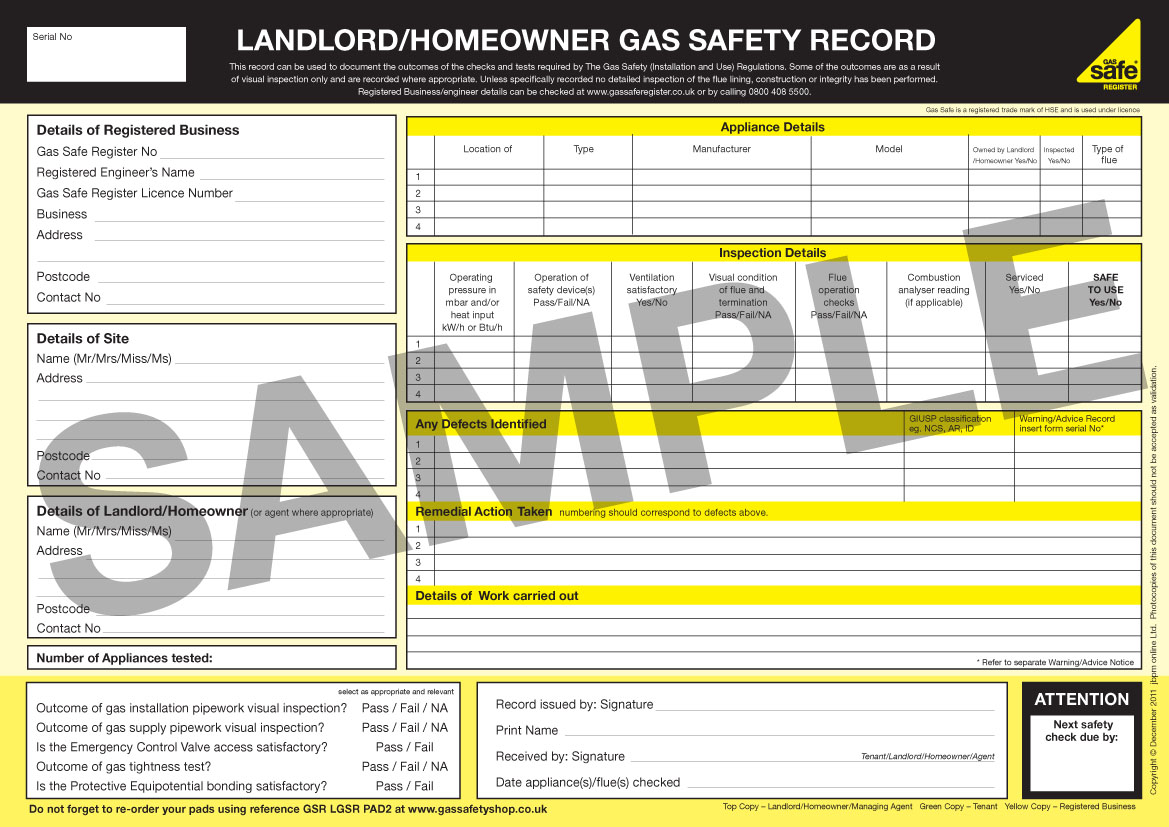
02 | What does a gas safety record look like?
A gas safety certificate is a carbon copy set of three colour coded sheets with a yellow ‘Gas Safe’ triangle showing in the top right corner. Each sheet is handed to a specific party relating to the day to day management of a property. The top (white sheet) is for the owner/landlord of the property. While the second (yellow sheet) is for any managing agent that is appointed and the last (pink sheet) is for the tenant to retain.
The certificate contains places to enter:
- the property’s address
- the landlord’s name & address
- the gas engineer’s name, address and Gas Safe Registered number
- a description and location for each appliance and flue checked
- the date on which the gas safety test was carried out
- any further actions taken or required to render the gas installation or appliances safe
You can see an example of a gas safety certificate here.
03 | Are gas safety records mandatory for landlords?
Yes!
Every landlord in the UK must have a gas safety certificate for any property with gas installations and appliances. The gas safety test must be carried on an annual basis. If as a landlord, you fail to do so, you are not only liable for an unlimited fine but can also be punished with six months imprisonment.
If you use a managing agent or sublet part of a building, you will need to ensure you know who is responsible for arranging the gas safety check. While sometimes managing agents do take responsibility, this is not always the case, and you should double-check who is in charge of gas safety when you hire them. Contrary to popular belief, having a managing agent in place does not absolve you of your responsibilities as a landlord. You are still legally obliged to ensure you hold a valid gas safety certificate as the owner of the property.
04 | Should owner-occupiers keep gas safety records?
Yes!
While it is not mandatory for an owner-occupier to hold an annual gas safety certificate, these can prove very useful when it comes to selling your property.
The TA6 property information form, which you fill in when you start your property sale, asks for a gas safety certificate. If you can provide this, you can accelerate the conveyancing process as additional checks will not be necessary as part of the survey.
This can also encourage potential buyers when you come to sell your home as it can help demonstrate that you take good care of it.
05 | What does a gas safety check consist of?
Gas safety checks can be divided into installation and appliance checks.
The appliances check deals with things like cookers, boilers, and fireplaces, while the installation check focuses on the infrastructure delivering the gas.
The gas installation safety check consists of testing:
- All accessible gas pipework being securely fastened
- All pipework tested for gas leaks. This if often called the gas tightness test.
The following should be carried out by a Gas Safe engineer during an appliance safety check:
- Checking the appliance is suitable for the room, Since 1998, most gas appliances have not been allowed in bedrooms.
- Checking the operating pressure and heat input of the appliance to ensure it is working to the manufacturer’s specifications.
- Ensuring that any flue or chimney used to remove gas fumes is connected properly and is not blocked.
- Checking the air supply is adequate and consistent as gas cannot burn safely without it.
- Ensuring all pipework bringing gas to the appliance is correctly fitted and intact.
- Finally, ensuring gas is burning cleanly and the appliance is properly set up.
If an appliance fails one of the checks, it will be condemned. The engineer will terminate the appliance form the gas supply and record this. They will then explain why this is the case and place a notice on the appliance to say it can no longer be used.
You must not use a condemned appliance as it can pose a substantial risk to your health and the health of others in a property.
If your engineer tells you your appliance has been emitting carbon monoxide, you should go straight to hospital for a general health check.
While this is a precautionary action, and you may have not been substantially affected, carbon monoxide poisoning is dangerous.
06 | What is the cost for a gas safety certificate?
Gas safety checks cost between £60 – £120.
This price range is typical for properties with one hob, gas fire, and boiler. If your home has more appliances than this, expect to be charged an additional £10 for each additional item.
In addition, the location of your home somewhat impacts prices. For example, gas checks for properties in London are likely to be more expensive than those in the rest of the country due to higher overheads.
07 | What if my tenant does not let the gas safe engineer in?
The contract you made with your tenant when you let your property to them will normally allow you access to conduct maintenance.
You should give your tenant as much notice as you can when you decide to carry out the annual gas safety check. We recommend you give them at least 48 hours’ notice and then follow this up with a polite reminder the night before your gas engineer is due to visit. If your tenant objects, you should inform them the gas safety check is required by law, is for their own safety, and let them choose an alternative date.
08 | Do I need a new gas safe certificate if I get a new tenant?
No, but it can be a good idea.
Before you re-let a property you should ensure all its gas appliances and installations are safe, and that it has an up-to-date gas safety record.
If the old tenant kept it in good condition, and the time it spent empty is short, your previous report should be sufficient.
However, if the property has laid empty for a long time, or an appliance could have been tampered with, it is advisable to get an engineer to conduct another assessment.
In addition, when a tenant takes an appliance with them, you should ensure it has been safely disconnected before new tenants move into the property.
If an appliance is left behind by a tenant and you leave it connected to the property after they leave, you will need to include it in a new gas safety record before you let the property once again.
Summary
A gas safety certificate is a document granted to a property owner after they have a gas safety engineer check both their gas installation and appliances.
These checks should be done annually, and typically cost between £60 – £120.
If you are a landlord, carrying out these checks is mandatory, and failure to do so without a very good reason could result in an unlimited fine or even imprisonment.
While gas safety checks are not mandatory for an owner-occupier, having one done annually is still a good idea. This is because it will help to ensure your property and family’s safety and will make your house more appealing to any potential buyers should you decide to sell.
Has this article been helpful? Let us know by leaving a short comment below.


Leave A Comment